REVIEW · PARIS
Private tour Paris 3 hours in vintage Citroën 2CV
Book on Viator →Operated by 4 roues sous 1 parapluie · Bookable on Viator
A 2CV makes Paris feel cinematic. This private ride mixes big-name landmarks with quick stops in places you’d miss on foot, all in a vintage Citroën 2CV style. You’ll get photo moments, practical city guidance, and a “drive-and-look” route that helps you understand Paris fast.
I love the photo-friendly stops that actually break up the sightseeing, not just a blur of car windows. I also love how the driver can explain what you’re seeing while steering you toward neighborhoods like Saint-Germain-des-Prés and Montmartre for later exploring.
One drawback to plan for: Paris traffic and road closures can shrink real sightseeing time, so on a bad day you may feel like you’re mostly in transit.
In This Review
- Key things to know before you book
- Why a vintage Citroën 2CV beats the usual Paris rides
- Meeting point, pickup options, and how the 3 hours really play out
- The route in plain English: what you’ll see and why it matters
- Montmartre and the Sacré-Cœur area: the photo stop that sets the tone
- The Latin Quarter and the Roman layer: Arènes de Lutèce
- Ile Saint-Louis and the Seine edges: where Paris looks like itself
- Panthéon, Fontaine Saint-Sulpice, and the Rive Gauche “brain” of Paris
- Musée d’Orsay and the “shape” of the Seine walk (without the walking)
- Place du Trocadéro: the Eiffel Tower viewpoint moment
- Arc de Triomphe and the big Paris axis payoff
- Comfort in a tiny car: blankets, water, and what to expect
- Price and value: what $192.89 per person buys you
- Drivers and guiding style: why names like Renaud and Jean-Remi stand out
- Common friction points to watch for (so you’re not disappointed)
- Quick tips to get the best photos without stress
- Should you book the Private Tour Paris 3 hours in vintage Citroën 2CV?
- FAQ
- How many people can ride in each 2CV?
- Is this tour private?
- Where do I meet the driver, and where does the tour end?
- Is hotel pickup available?
- What language is the tour offered in?
- What’s included for comfort during the ride?
- Can I cancel if my plans change?
Key things to know before you book
- Small-car comfort (and the seat math): Each 2CV is limited to three people for comfort (not counting the driver). Larger groups can run in a convoy.
- A private guide, not a bus tour: You get your own driver-guide, with time to ask questions and request tweaks.
- Big sights plus quieter stops: The route includes Arc de Triomphe, Notre-Dame area, Louvre area, Eiffel views, and also less-visited spots like Luxembourg Gardens and Place Vendôme.
- Brief, targeted photo stops: Several listed stops are just a couple to five minutes, so move quickly with your camera.
- Comfort extras included: Bottled water and blankets are provided, which matters in the rain or when temps dip.
Why a vintage Citroën 2CV beats the usual Paris rides
This is one of those Paris ideas that sounds like a gimmick until you’re in it. The vintage Citroën 2CV is small, low, and unmistakably French. When you roll past landmarks and through tight streets, it feels like you’re seeing the city through an old movie prop.
The bigger win is how the car changes the pacing. You’re not stuck in a long bus line, and you’re not trudging across the city for every view. Instead, you glide from spot to spot, then hop out when it’s worth it—especially for the angles that make great travel photos.
Also, because it’s a compact car, people tend to pay attention. Expect people to look, point, and sometimes even take photos of you. It’s silly in the best way, and it turns a normal sightseeing day into a memory that feels uniquely Paris.
You can also read our reviews of more private tours in Paris


Meeting point, pickup options, and how the 3 hours really play out
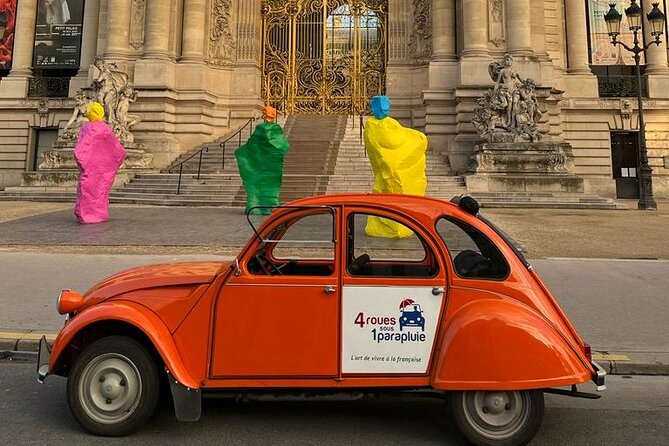
Most bookings start near Petit Palais (Av. Winston Churchill, 75008 Paris). Other departures may let you start from the Avenue des Champs-Élysées area or add a pickup from a city-center hotel, depending on your selection.
The tour runs for about 3 hours, and yes, that time includes the reality of Paris traffic. On a calm day, you’ll feel like you did a lot. On a slow or closure-heavy day, you’ll feel those minutes slip away.
Here’s how to make the timing work for you:
- Choose a departure time when you expect fewer bottlenecks (weekends can be easier than you’d think).
- Have one plan for photos that matters most to you, and let everything else be a bonus.
- If you care most about a specific neighborhood stop, ask the driver early whether it can be prioritized within the route.
And if weather matters for you, remember the 2CV can be more “open-air” depending on roof setup. If conditions allow, that can improve viewing angles.
The route in plain English: what you’ll see and why it matters
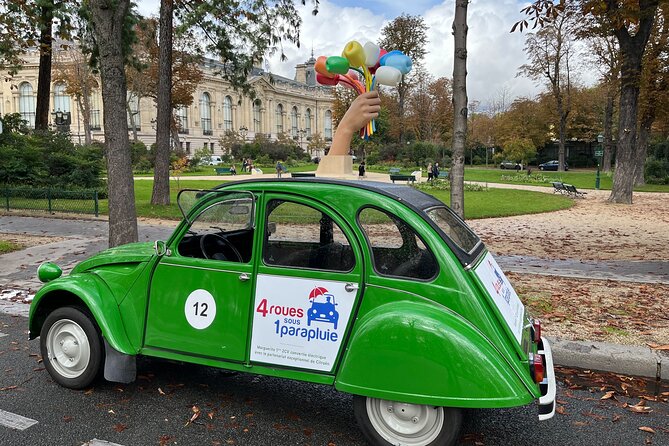
This 2CV tour is built like a fast orientation sweep. You’ll pass through classic Paris axes and tourist anchors, then add some stops that make you say, Oh, I didn’t expect that.
You’ll see sights such as Arc de Triomphe, Notre-Dame area, Louvre area, Moulin Rouge, and the Eiffel Tower area from viewpoints and photo stops. Then the route continues through neighborhoods with a different texture—Saint-Germain-des-Prés on the Left Bank, and Montmartre up on the hill.
A key point: some stops are very short (like the listed 2–5 minute photo windows). That doesn’t mean they’re worthless. It means you should be ready to get out, grab the shot, and move on.
Montmartre and the Sacré-Cœur area: the photo stop that sets the tone
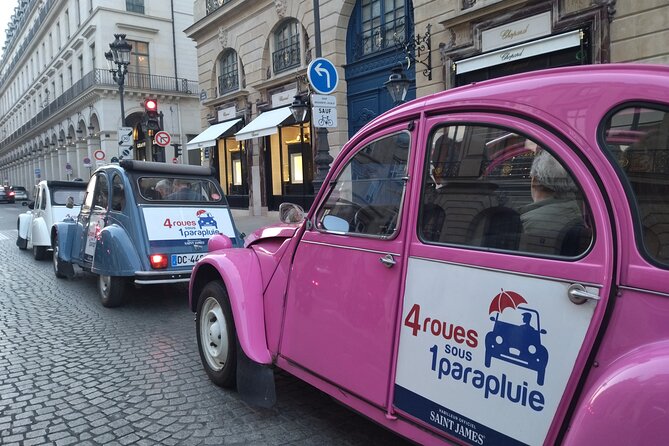
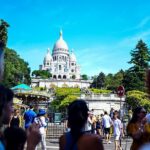
One of the stops is Basilique du Sacré-Cœur de Montmartre (free; listed around 5 minutes). Even with a short stop, the payoff can be big because the area gives you that “Paris on a hill” feeling in one sweep.
The plan also includes Montmartre itself (listed around 5 minutes). This is where the 2CV vibe shines: narrow streets, steep angles, and a view that looks postcard-perfect without needing a long walk.
Practical note: if public access is limited that day (street closures happen), the driver may have to adjust. Your best move is to communicate your priorities at the start: is your top goal Sacré-Cœur, photo lanes around Montmartre, or just the overall neighborhood feel?
The Latin Quarter and the Roman layer: Arènes de Lutèce
The itinerary includes Arènes de Lutèce (short stop, listed around 2 minutes; listed as free). It’s the kind of place you’d never stumble into by accident, because it doesn’t scream tourist stop the way the big museums do.
Why it matters on a tour like this: it adds depth to your Paris mental map. You see the modern city, then you get one quick reminder that parts of Paris started as Roman-era life.
If you love these small “wait, what is that?” moments, you’ll like this stop.



Ile Saint-Louis and the Seine edges: where Paris looks like itself
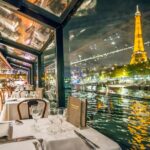
The route includes Île Saint-Louis. Pair that with Pont-Neuf (included) and you get the classic Seine rhythm: riverside views, bridges that define directions, and a sense of how the city is stitched together.
This is also the part of the day that’s great for quick photos from the sidewalk or a bridge viewpoint. You get recognizable Paris shapes without needing to plan museum hours or long walks.
If you’re sensitive to cold or rain, have your layers ready. Being out for a couple minutes multiple times adds up.
Panthéon, Fontaine Saint-Sulpice, and the Rive Gauche “brain” of Paris
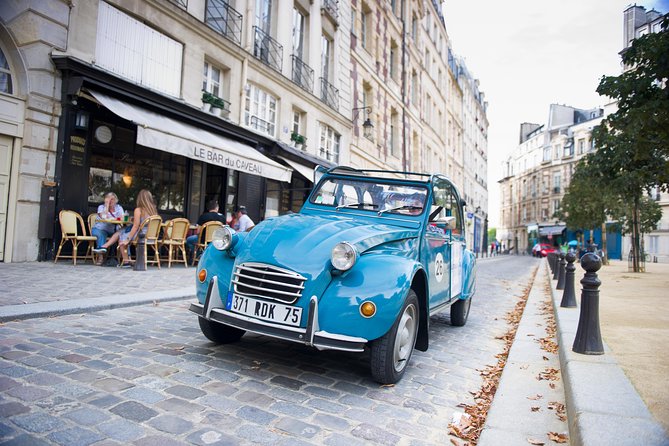
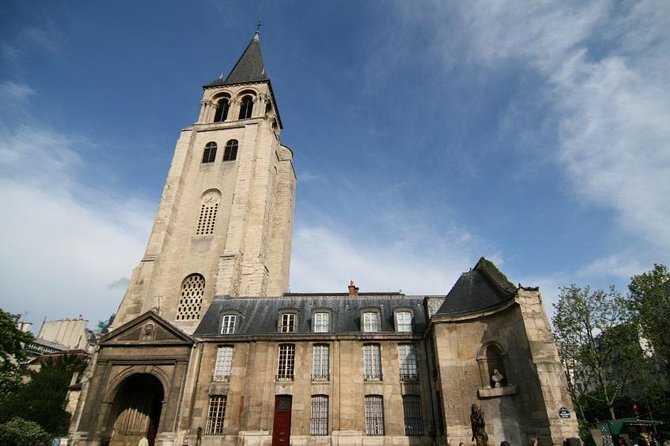
The itinerary touches Panthéon, Fontaine Saint-Sulpice, and Quartier Saint-Germain-des-Prés—all listed as stops along the way.
I like this stretch because it changes the scenery. Instead of focusing only on monuments, you’re moving through the city’s intellectual and Left Bank feel. You also get a chance to ask questions while you’re there, so you don’t just see names on signs—you connect them to what’s around you.
For later, this is the part that helps you choose what to do next. After your 2CV ride, you’ll have a better sense of where to wander for cafés, bookshops, and streets with more local energy.
Musée d’Orsay and the “shape” of the Seine walk (without the walking)
Musée d’Orsay appears on the route. Even if you don’t go inside, passing by (and getting a quick look) helps you understand the bridge-and-river composition of this part of Paris.
You also get other political or civic landmarks along the route such as the Assemblée Nationale. The tour doesn’t ask you to study details for hours. It gives you orientation—then you decide what deserves a deeper visit later.
Place du Trocadéro: the Eiffel Tower viewpoint moment
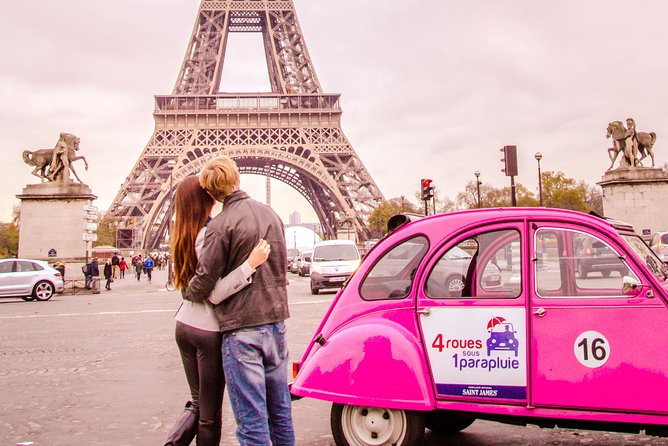
The itinerary includes Place du Trocadéro-et-du-11-Novembre (short stop, listed around 5 minutes). This is a key photo window for Eiffel Tower views, and it’s one of those stops where you’ll want to step out immediately when the driver parks.
Even if you’ve seen Eiffel photos before, this is the moment you understand the scale. You see how Paris frames the tower with river bends, bridges, and the right angle of streets.
If weather is messy, ask your driver what roof setup is safest and whether there’s a sheltered route for your photos. A good driver will think about viewing and timing.
Arc de Triomphe and the big Paris axis payoff
Arc de Triomphe is included. With a short Paris drive, this kind of monument matters because it anchors the entire city layout. Once you’ve been near it, you start to recognize how other sights line up.
The tour also includes multiple other named squares and viewpoints (like Place Gérard-Oury and the area called Bastille at the end of the itinerary list). These are great for quick “I’m here” photos and for helping you understand which direction you should go next on your own.
Comfort in a tiny car: blankets, water, and what to expect
The best practical detail here is that you get bottled water and blankets. That’s not a luxury add-on. It’s the difference between enjoying the ride and rushing through the day because you’re uncomfortable.
Because the car is smaller than most modern vehicles, seating is limited to three people per car. This is part of why the tour works so well for photos: the driver can focus on route and stops instead of squeezing people.
Also, if you’re booking for a group of up to nine, understand that you might ride in a convoy of separate cars with separate drivers. It keeps the comfort level, but it means you won’t be together in one vehicle.
What to wear:
- Layers you can add/remove quickly (Paris weather changes fast).
- Shoes you’re comfortable with for brief sidewalk exits.
- A camera/phone strap or easy grip. You’ll step out often enough that fumbling gets annoying.
Price and value: what $192.89 per person buys you
At $192.89 per person for about 3 hours, the cost isn’t “budget,” and it shouldn’t pretend to be. This is paying for the format: private guide, vintage car, and that quick-hit route that takes you to many key sights without you navigating traffic and parking.
Here’s the value logic that usually makes this tour make sense:
- If you’re traveling as a couple or small group (three people is the sweet spot), the per-person price becomes easier to justify.
- You’re buying time savings. Your driver handles route choices, traffic management, and stop planning.
- You get comfort extras (water and blankets) and enough photo windows to justify the car itself.
For solo travelers, it can still be a great experience if you really want the 2CV element and a private guide. Just compare it to what you’d spend on multiple transit tickets plus a guide-only tour.
If you’re on a tight schedule, this tour is often worth the premium because it gives you a working mental map of Paris in one afternoon or morning.
Drivers and guiding style: why names like Renaud and Jean-Remi stand out
The quality of this tour can hinge on the driver-guide. In the operator’s orbit, people mention guides including Renaud, Jean‑Remi, Vladimir, Alex, Dove, Nicholas, Matthew, Robert, and Jeane. Across these names, one theme comes up: calm, patient driving and clear explanations of what you’re seeing.
The good guiding shows up in small ways:
- The driver stops when a view is worth it, not just when it’s convenient.
- The guide tailors the day a bit based on what you care about.
- You get “how to think about this area” notes, not only monument labels.
On the flip side, a short 3-hour day leaves less room for mismatches. If you end up on a day with closures or a driver who doesn’t match your expectation for history or language comfort, the whole experience can feel overpriced fast.
My advice: at the start, tell your driver what you want most—architecture, neighborhood vibe, photo angles, or quick context—and ask whether they can steer accordingly.
Common friction points to watch for (so you’re not disappointed)
Based on real-world experiences, here are the issues worth mentally preparing for:
- Road closures and reroutes: Public access changes quickly in Paris. If Montmartre or another area is affected, you may end up driving more and stopping less.
- Time spent in traffic: The 3 hours include idle time. You can’t eliminate it, but choosing the right departure window helps.
- Food or voucher stops can be day-dependent: Some sweet breaks like macarons and coffee have been part of the experience on certain days, but it’s not something to assume 100% without confirming the plan for your specific departure.
- Late starts happen occasionally: If your tour starts late, it compresses everything else—photo stops included.
The simplest fix: ask one clear question at the meeting point. What are your planned stops for my exact departure, and which one is most impacted by traffic or closures today?
Quick tips to get the best photos without stress
- Build your photo priority list before you meet. You’ll be juggling landmarks and exits, and it helps to know your top three shots.
- Wear a light layer even in warmer months; the 2CV is more open-air than you might expect.
- When the driver pulls over, don’t second-guess. The best shots often mean a quick move and a fast angle.
- If it’s rainy, ask what you can do for roof setup and whether there’s a quick sheltered spot for Eiffel or Arc de Triomphe views.
Should you book the Private Tour Paris 3 hours in vintage Citroën 2CV?
Book it if you want:
- A private way to see a lot of Paris quickly.
- A unique ride that turns heads and makes your photos more fun.
- A driver who can share practical neighborhood notes so you can wander better afterward.
Skip it (or rethink timing) if:
- You’re hoping for long stops inside famous sights. This tour is built for views and short photo windows.
- Your schedule is extremely strict, because traffic and closures can change the flow.
- You’re planning around a specific food stop. Sweet breaks may or may not happen depending on the day’s plan.
For most people, this is a smart first- or mid-trip Paris activity. It helps you orient yourself, then decide where your real walking days should happen next.
FAQ
How many people can ride in each 2CV?
Each vintage 2CV is limited to three people for comfort, not including the driver. If your group is larger, you can still book, and multiple cars can run in a convoy.
Is this tour private?
Yes. It’s a private tour/activity, meaning only your group participates.
Where do I meet the driver, and where does the tour end?
The tour starts near Petit Palais on Av. Winston Churchill (75008 Paris) and ends back at the meeting point. The operator also notes that drop-off can be at your hotel or at the Champs-Élysées pickup point, depending on the arrangement.
Is hotel pickup available?
Pickup is offered. Depending on your departure option, you can meet near Avenue des Champs-Élysées or choose pick-up at your city-center hotel.
What language is the tour offered in?
The tour is offered in English.
What’s included for comfort during the ride?
Bottled water and blankets are provided to help you stay comfortable during the drive.
Can I cancel if my plans change?
You can cancel for a full refund up to 24 hours before the experience’s start time. If you cancel later than that, the amount you paid will not be refunded.